
All About Ice and Ice Machines – An Innocent Food Safety Hazard
Ice and ice machines seem pretty innocent; it’s frozen water, after all, seems pure. What could go wrong with that? At freezing temperatures, no microorganisms could survive – could they? If there was a problem, the government would have regulations – wouldn’t they?
Quick Facts and Effects:
Bacteria do not die in the freezer or in ice. They do not grow but lie dormant (inactive) until their environment is more favorable. Pathogens (disease-causing bacteria) like Salmonella, E. coli, Norovirus and Listeria survive in contaminated ice and are infectious if that ice finds its way into a slushie or other drink.
When ice becomes contaminated – by soiled hands, unprotected plumbing, the failure to clean and sanitize – it becomes a vector transmitting the contamination to food or drinks. A study of hospitals and nursing homes in Ohio found contamination in 64 ice machines, isolating gram negative bacilli (ex. E. Coli) in drain pans, water chutes and drain pan grills. An article published by the International Packaged Ice Association cites numerous examples of contaminated ice machines leading to sanitation concerns.
You might expect the growth of mold or slime in an unclean ice machine but these examples also show the presence of pathogens like Staphylococcus aureus (common on hands), E. Coli, Salmonella and Listeria. Mold and slime are disgusting examples of poor sanitation but much worse, they create biofilms which create hiding places for pathogens.
Molds also produce mycotoxins, a source of carcinogens and allergens, chemically stable, persistent after the visible mold is removed. In contaminated food, mycotoxins produce symptoms from immediate (allergic reactions, respiratory irritation and stomach distress), longer term symptoms (liver or kidney damage, increased cancer risk), especially in high risk populations such as infants, young children, the elderly and those with compromised immune systems.
Aren’t There Regulations?: Yes!
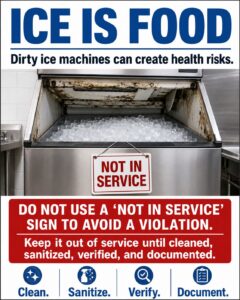
The Food and Drug Administration considers ice to be a food, perhaps not a TCS food but a food, nevertheless. Ice can be a vector, transmitting contaminants (biological – bacteria, molds, viruses; chemical and physical) into drinks and foods. Restaurants (small scale food operations) putting ice in drinks or a slush machine reservoir are exempt from specific ice machine regulations but are inspected by State or local food inspectors. Packaged ice manufacturers have more stringent regulations about packaging and labeling ice, centered in the Current Good Manufacturing Practices published by the CFR (compiled federal regulations – 21 CFR Part 110) and the FDA.
How Do Ice Machines Become Contaminated? Here are some things to watch out for when monitoring ice machine sanitation. Hint: the same food guidelines used for food safety apply here:
(1) Poor Personal Hygiene – Avoid bare hand contact with the ice – it would be considered a ‘ready to eat’ food. Wash hands, wear single use gloves and use a sanitized ice scoop. In one case, Staphylococcus aureus was isolated from an ice machine, suggesting an employee contaminated the ice through poor personal hygiene
(2) Monitor the Water Supply – Many health departments conduct Cross Connection Surveys of public water supplies, to identify and control any physical links, cross connections, between drinking (potable) and contaminated (non-potable) water sources. Be certain your water supply is safe for use. It should be tested at least every three months, for bacteria and common chemicals, and you should have a record of the sample results on file.
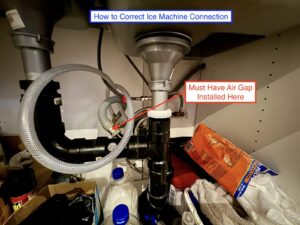
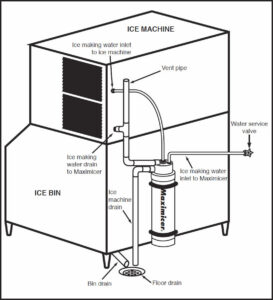
(3) Check the Plumbing and Water Protection – Pipes must be color coded and labeled so there is no chance of a cross connection occurring between sources. There are three places where the ice machine water line must be protected with air gaps or backflow protection devices. First, The ice machine must have backflow protection where potable water pipes divert to the machine. Second, there must be an internal air gap where the water enters to create ice. Last, the machine drain line must have an air gap above the floor drain so wastewater cannot back up. (see the graphics at the start of this article)
(4) Clean and Sanitize – Ice machines have specific cleaning procedures, above and beyond the cleaning and sanitizing steps all certified managers know (Scape soil, wash, rinse, sanitize, air dry).
Remember to change both the air filter (look behind the grill plate) and the water conditioning filter regularly (use the manufacturer’s guidelines; change more frequently if there is a higher use.) These components are critical to reduce mineral deposits which make cleaning more difficult (these minerals, along with poor sanitation, create biofilms).
Now, to clean and sanitize the machine:
(1) The cleaner must be approved by the Environmental Protection Agency and be safe for the ice machine (harsh chemicals can damage the machines internal parts – check the manufacturer’s manual);
(2) Three buckets are needed – one for the cleaning solution; a second for warm rinse water (essential to prevent mixing the cleaner and sanitizer); and a sanitizing solution (be sure you are using an approved sanitizer in the proper concentration – use a test kit to be sure). Be sure the buckets are properly labeled;
(3) Use soft clothes, nylon brushes to get into cracks and crevices; and protective gear to protect the person doing the cleaning.
(4) Unplug the ice machine, disconnect the water supply and empty the machine
(5) Remove the internal machine parts, clean and sanitize them, lay them out to air dry
(6) Follow the manufacturer’s instructions to circulate the cleaner through the machine. During that cleaning cycle, use brushes, wiping cloths, etc. to clean and sanitize the exterior of the machine. After the cleaning cycle concludes, clean any remaining soil and debris inside the machine and rinse several times to remove remaining detergent.
(7) Run sanitizer solution through the machine (use an EPA approved sanitizer – cheaper chemicals may have the same active ingredient but might contain unapproved residues). After the cycle concludes, spray or wipe down the machine interior with sanitizer; remember the ice scoop and bucket. After everything air dries, run several batches of ice through the machine and discard them.
(8) Develop a cleaning schedule for the machine exterior, the air and water filters and the condenser coil. Remember to clean the top of the machine where the ice bucket is inverted. The cleaning and maintenance schedule should depend on the amount of use, not a calendar date.
(9) Never use the ice machine to store drinks, bottles or food. Always keep the ice bucket stored inverted on a clean surface, never the floor.
(10) Remember to give the same attention to ice bins and storage units at serving areas and the bar. Store ice scoops handle up out of the ice, never inside an ice machine – it will be buried.
(11) If you aren’t sure (it took lots of time reading and researching this article!!), talk to manufacturers and suppliers, read the websites and don’t guess.
Sources:
(1) Can Restaurant Ice Make You Sick? Food Safety Experts Reveal What You Should Know
Alexandra Emanuelli HuffPost https://www.huffpost.com/author/alexandra-emanuelli
(2) K. Jalava, A. Kauppien, H. Al-Hello and S. Rasanen Epidemiol Infect 2018 12(3) V. 147 (57)
“An outbreak of norovirus infection caused by ice cubes and a leaking air ventilation valve”
(3) Alicia Maroney 8/6/2025 https://www.foodpoisoningnews.com/ice-machines-the-overlooked-food-poisoning-culprit/ Ice Machines: The Overlooked Food Poisoning Culprit
(4) Ice Contamination Reports https://www.safeice.org/ice-contamination-reports.html
(5) Sean Kearny November 7, 2025 The Restaurant Warehouse https://therestaurantwarehouse.com/
“How to Clean an Ice Machine: A Pro’s Guide”