
A picture of Salmonella

A picture of one ATP meter
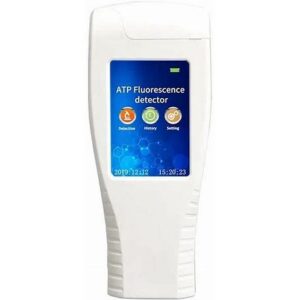
The Article:
Pathogens prefer living in liquids, free-floating, like plankton in water; this growth condition is called ‘planktonic’. While they grow better this way, they survive better in colonies with other bacteria, protected against stressful conditions. Biofilms (“Biofilms and Food Service Cleaning” 1/30/25 blog post) are this protection, a film of slime, grease or food waste on surfaces where cleaning has been incomplete or ineffective. While biofilms take time to develop on a surface, once established, they are only susceptible to diligent cleaning with strong detergents.
Most food borne disease bacteria, Listeria, Salmonella, E. Coli for three, are capable of forming biofilms, evading routine cleaning procedures and posing significant health risks to consumers.
This film takes time to develop to the point where bacteria can be protected. Planktonic bacteria attempt to attach to a surface and, if there are surface defects to allow attachment (a cutting board with knife cuts, a surface with scratches and abrasions), the bacteria begin multiplying and producing polymers (proteins, genetic materials like RNA and DNA, cellulose and starch) as part of their metabolism. This biofilm structure, if well established, allows bacteria to coordinate their activities, maintain the biofilm’s stability and making cleaning much more difficult. The biofilm provides them the capacity to transfer genes conferring resistance, to prevent the biofilm from drying out and to impede the penetration of sanitizers. In health care settings, antibiotics are not as effective. Eventually, biofilms deplete nutrients and break apart, forcing bacteria to spread and attach to other surfaces.
Bacteria in these environments might survive for long time periods, depending on the type of bacteria and the level of soil on the surface. (Salmonella, for instance, survives for up to 60 days in soil). Biofilms might be found in a variety of places, such as living tissues, medical devices, industrial or potable water system piping or natural aquatic systems. In a food service facility, the concerns are many: plumbing (drains); processing equipment (conveyor belts, equipment gaskets and seals); food storage tanks; refrigeration; any porous work surfaces, utensils, equipment or floors, walls and ceilings. In healthcare settings such as hospitals, biofilms have been found on medical devices, including implants, catheters, endoscopes and various environmental surfaces, and are a significant cause of hospital-acquired, ‘nosocomial’ infections. Dentists bother their patients to brush their teeth twice a day, to prevent against biofilm formation.
Measuring Biofilms – A food service might want to monitor its cleaning effectiveness. Or, faced with a regulatory closure or recall, a manufacturing plant might need to demonstrate the absence of pathogens such as a Listeria.
Monitoring is critical because biofilms, once established, are resistant to routine cleaning and can harbor pathogens. Without monitoring and effective cleaning, repair or replacement of damaged infrastructure (surfaces, equipment, floors and walls) and effective employee hygiene (hand washing, clean clothing and footwear), pathogens can reenter and contaminate. In fact, there are numerous case studies of resilient pathogens like Listeria doing just that.
There are several areas of concern for monitoring effectiveness: (1) Surveys of suspected areas using visual observations and surface swabs (ATP); (2) Monitoring high risk, high volume areas (food storage and contact areas) more frequently; (3) Control humidity, temperature and ventilation – pathogens like stagnant, warm, humid environments; (4) Follow up testing in laboratories where surveys show problems; (5) Testing for indicator organisms as well as pathogens – a food product may test negative for pathogens but still pose a risk if indicator counts are high. Elevated indicator organisms (total coliform, total aerobic plate count, enterobacteriaceae) might indicate poor sanitation favorable for cross-contamination and further pathogen growth. Both tests, pathogens and indicator organisms, are important.
VBNC status – ‘you cannot measure what you cannot see!’
Pathogens are not destroyed merely by depriving them of nutrients and moisture; time and temperature are the two most significant factors controlling growth. Pathogens deprived of ideal growth environments are not destroyed but lie dormant, waiting for more ideal conditions.
In biofilms, when the environment is harsh (low pH, lack of nutrients, presence of sanitizers and chemicals), pathogens may enter, and exit, a state called VBNC, ‘viable but non culturable’. Lack of essential nutrients, high and low temperatures, disinfectants, and changes in pH can all create this condition. Salmonella, particularly Salmonella enterica, enters this state during low temperature food storage (39.20F and -40F). In one research study, this strain of bacteria was dormant in rice and flour, but still able to transmit genetic material. The bacteria cannot be cultured on nutrient media that normally would support their growth but still can revive and grow under better conditions. (Pathogens in dried or frozen foods are dormant, not destroyed.) Thus, S. enterica cells could enter into the VBNC state depending on food type and storage temperature, leading to false negative detection results by culture-based methods. Thus a food service facility attempting to reopen for business might rely on a negative surface analysis of the slicer, equipment and production area, only to find recontamination later from dormant cultures. VBNC organisms are difficult to test for, outside a laboratory. This is an important reason to analyze for organic residues as well as pathogens. A high test result from an ATP meter or surface swab, for example, would indicate a need for further laboratory testing.
Talking Points? 1. Routine audits of the facility for damaged equipment and surfaces is vital. Damaged, defective, worn equipment is not easily cleanable, creating a potential for biofilm formation. Porous, damaged floors and walls provide ‘hiding’ places for bacteria. Replace or resurface these areas immediately 2. Incomplete cleaning leads to biofilms which can allow the spread of pathogen contamination throughout the facility. Write up a complete cleaning schedule, train employees in its use and evaluate effectiveness regularly, emphasizing the high use, high risk areas. 3. Without regular evaluation of cleaning methods and frequency, surface microbiological testing could produce a false positive result, missing VBNC pathogens ‘hiding’ in biofilms. This is an excellent reason to visual observe behaviors and conditions regularly, as well as quick survey checks for indicator organisms.
Notes:
(1) ATP – adenosine triphosphate – this substance is present in all living cells as well as organic residues. The ATP meter provides a quick, real-time check of sanitation effectiveness.
(2) ‘Pathogen’ – a disease-causing bacteria which does not leave a trace in the food, unlike ‘spoilage’ bacteria which causes a change in odor, taste, smell or appearance.
(3) Pathogens are living organisms and understanding their environment helps to control them.
(4) The study of Salmonella enterica shows that the 410F requirement for TCS foods is the highest allowed cold temperature; bacteria such as Listeria and Salmonella can grow slowly at lower cold temperatures. It is always best to keep TCS foods as cold as possible, even lower than 410F.
References:
https://www.osmosis.org/answers/biofilm
Anna Hernandez, MD “Biofilms What Are They, Formation, Removal, and More
Evita Balducci; Francesco Papi; Daniela Eloisa Capialbi; Linda Del Bino Int J Mol Sci
. 2023 Feb 17;24(4):4030. “Polysaccharides’ Structures and Functions in Biofilm Architecture of Antimicrobial-Resistant (AMR) Pathogens”
Food Microbiology, 2026 Jun:136:105009 Junyan Liu; Zhenbo Xu; Tengyi Huang’ Thanapop Soteyome; Yagin Li; Yuting Luo, Yuzhu Mao; Lei Yuan; Aijuan Xu; Zhijian Zeg; Shaohong Huang, Mahesh Premarathna, Yanrui Ye “Salmonella enteric biofilm is capable of VBNC state formation and virulence gene expressing during low temperature food storage” Abstract
Jean-Yves Maillard, Andrew McBain “Biofilm in healthcare settings and their control”
Letters in Applied Microbiology, Volume 68, Issue 4, 1 April 2019, Page 268, https://doi.org/10.1111/lam.13147
Darlious Senior “Indicator Organisms vs Foodborne Pathogens in Food Microbiology Testing”
December 31, 2025 in https://myfoodsafetylab.com/indicator-organisms-vs-foodborne-pathogens-in-food-microbiology-testing/
“Your Guide to Adenosine Triphosphate (ATP) Testing” 9/24/2025 in https://www.neogen.com/en/usac/neocenter/blog/your-guide-to-atp-testing/
“How to Spot and Prevent Biofilm Formation in Food Facilities” in https://kismettechnologies.com/how-to-spot-and-prevent-biofilm-formation-in-food-facilities
Xiaoqi Wang, Chunjing Chen, Jue Hu, Chang Liu, Yi Ning, Fangguo Lu “Current strategies for monitoring and controlling bacterial biofilm formation on medical surfaces” Ecotoxicology and Environmental Safety V. 282, 9/1/2024 116709