
Food Additives, Adulterants and GRAS (Generally Recognized as Safe)- What’s Approved, How Do You Know?
Ask a consumer about food additives and the response will probably be negative. There is an increasing demand for foods that are ‘wholesome’, not ultra processed, with no unnecessary ingredients or chemical residues.
Everyone wants their food pure and wholesome, right? Yet, unless the food comes directly to the restaurant, or a consumer’s home, from a farmer’s field or slaughterhouse, it’s rare to find foods that don’t receive some degree of processing. The pathway from the producer to market can be lengthy, with any number of handlers and intermediate processing; food ingredients, often with strange, hyphenated names, play an important role in assuring foods arrive safe and in good condition.
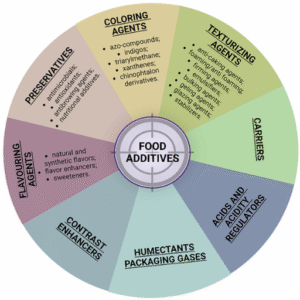
Additives Defined
What is a food additive anyway? Here are two definitions:
The World Health Organization defines an additive as….
…substance primarily added to processed foods, or other foods produced on an industrial scale, for technical purposes, e.g. to improve safety, increase the amount of time a food can be stored, or modify sensory properties of food
Source: https://www.who.int/news-room/fact-sheets/detail/food-additives
The United States Food and Drug Administration (FDA) defines an additive this way:
any substance the intended use of which results or may reasonably be expected to result – directly or indirectly – in it becoming a component or otherwise affecting the characteristics of any food. An important note: this definition excludes substances that are GRAS, prior-sanctioned, color additives, pesticides, or dietary ingredients in supplements
Source: https://www.fda.gov/food/food-additives-and-gras-ingredients-information-consumers/understanding-how-fda-regulates-food-additives-and-gras-ingredients
An additive is ‘added’ to foods to improve them in some way, either increasing their shelf life or making them safer by making pathogen growth more difficult. Some ingredients like sugar, salt or spices dehydrate the food while others such as vinegar or sodium compounds adjust the food’s acidity. These ingredients become a part of the food, affecting its character and characteristics.
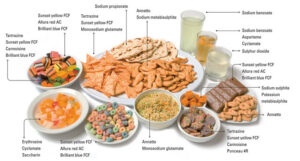
Additives are important to modify sensory properties of food, including taste, smell, texture and appearance. They are important in developing safer foods, altering the pH and water activity to discourage the growth of pathogens and modifying the taste and appearance of food.
A food additive is not normally consumed as a food by themselves and not normally used in a food recipe. Additives are used more by food wholesalers and manufacturers as part of a HACCP plan or variance approved by regulatory prior to use.
What an Additive Does Not Include
The term ‘additive’ does not include ingredients that either are labeled as GRAS (‘generally recognized as safe’) or have been authorized for use by the government prior to 1958. For example, sodium nitrite and potassium nitrite are approved for use to preserve luncheon meats. Color additives, pesticides and dietary ingredients are not considered additives: they are regulated under separate laws. (More about GRAS ingredients below.)
Note: Pesticides are regulated by the Environmental Protection Agency; GRAS and color additives are regulated by the FDA through the Federal Food Drug and Cosmetic Act.
Additives and the Restaurateur
So how could this discussion affect the average restaurateur? It might seem as if this discussion belongs with the wholesale and manufacturing sector, not a retail operation. Yet, there are any number of ingredients proposed to liven up traditional foods. It becomes critical to be sure they are approved for use. When the author first began his career as a sanitarian, the big concern was using edible flowers and how to be sure they were an approved variety. Today, there are many more ingredients to consider. A few are included here, not to guarantee their safety but to suggest the importance of proactive research prior to use.
A reputable distributor should be aware of the source and safety of the ingredients, as well as the reliability of their intermediate suppliers
Here’s a list of some ingredients proposed on websites:
Yuzu – A Japanese citrus with floral notes, tart juice, and aromatic peel. It’s used in dressings, marinades, and cocktails to add brightness and complexity:
Ube (Purple Yam) – A vibrant, sweet-tasting root vegetable from the Philippines, used in desserts like ice cream, cakes, and pastries for color and flavor without artificial dyes
Seaweed Varieties (Dulse, Nori, Kombu) – Beyond sushi, these ocean vegetables add umami, minerals, and natural saltiness to broths, salads, and snacks
Pistachios – Gaining popularity in plant-based cooking for their green hue, natural sweetness, and versatility in milks, butters, flours, and as a crunchy topping
Sour Cherries – Tart and acidic, they’re moving from pies into savory dishes, sauces, and roasted vegetables for a bright contrast
Dried Peppers (Ancho, Guajillo, Cascabel, Aleppo) – Complex, smoky, and heat-rich, these can be rehydrated, ground, or infused into sauces and oils
White Miso – A quick umami booster for sauces, dressings, and soups, adding savory depth in seconds
Pomegranate Molasses – A sweet-sour finishing touch for roasted vegetables, grilled meats, and salads
Tempeh – A firmer, nuttier alternative to tofu, ideal for stir-fries, sandwiches, and plant-based meals
Heirloom Fruits & Vegetables – Unique varieties with distinct flavors and textures, often used for both taste and visual appeal List.
Functional Botanicals – Ingredients like adaptogens, plant-based omega-3s, and probiotics that offer health benefits alongside flavor
Upcycled Ingredients – Fruit fibers, protein-rich by-products, and other waste-derived components used to reduce environmental impact
Global & Fusion Flavors – Blends like kimchi fried rice arancini or za’atar-infused plant-based products, reflecting cross-cultural culinary creativity
Precision Fermented Proteins – Lab-created proteins and bioactives that mimic animal products while being sustainable
Edible Glitter & Whimsical Textures – Playful, colorful elements for visually striking plating
Recent GRAS Loophole Review
A side note about GRAS (‘generally recognized as safe’) ingredients. While the term appears to imply a pure, safe product, it has numerous exceptions. It’s also important to note that every ingredient declared to be GRAS does not mean the FDA has reviewed and approved it. It only means that the ingredient is legally permitted in the food system based on the currently available legislation and guidance.
Under the Federal Food Drug and Cosmetic Act, there are two ways, historical and scientific, for food manufacturers to confirm an ingredient’s safety and GRAS status.
The first, a historical proof, is based on the ingredient’s commonly accepted use prior to 1958. The ingredient must have been in common use by a large number of people, used for only one purpose (e.g. food preservative), not used in drugs or cosmetics, and used without any harmful effect. Baking soda, vinegar, sugar and salt are four of many examples.
The second proof, a scientific process, requires gathering scientific data about the ingredient and obtaining a positive review by reputable experts. The manufacturer can then decide to either self-affirm the GRAS status or request a review by the FDA. The self-affirmation process was established by law so manufacturers would not have to wait to use the ingredient for what might be a lengthy FDA review. However, the self-affirmation process would be illegal if there is not compelling scientific data to support the contention of safety; the data is misleading or misrepresented.
The problem with this system, at least from the consumer’s point of view, is there is no way to determine how many GRAS ingredients are in use under the voluntary system. Therefore, the federal government (Department of Health and Human Services) has proposed changes to convert the voluntary GRAS notification program to a mandatory status. For voluntary, self-affirmed ingredients already in the system, there will be a deadline for notifying the FDA. The rule is open for public comment at this time.
Unapproved Ingredients
While the discussion so far has been the ambiguous nature of the GRAS process, there are definitely ingredients that the FDA considers unsafe and illegal. A list of twelve was recently published but there may be many more that are unknown.
Under 21 CFR Part 189 (see the reference below), the FDA has prohibited certain substances from use in human food because they are unsafe or lack adequate scientific data. Examples include:
Coumarin (tonka bean extract)
Calamus (sweet flag) flavoring compound
Cinnamyl anthranilate (synthetic fruit/cinnamon flavoring)
Cobaltous salt and derivatives – foam stabilizer in fermented malt beverages
Cyclamate and derivatives – sweeteners
Diethylpyrocarbonate – used to ferment alcoholic beverages
Dulcin – synthetic chemical proposed to replace sucrose
Safrole (root beer/sassafras flavoring)
Thiourea (antimycotic for use in dipping citrus)
Chlorofluorocarbon propellants (self-pressurized containers)
P-4000 (artificial sweetener)
Monochloroacetic acid – preservative in beverages
Nordihydroguaiaretic acid (NDGA) – antioxidants in food
Read the ingredient labels carefully and be sure all suppliers provide letters of guarantee that they comply with all regulations. This also applies to food equipment and packaging.
In addition, the same regulation establishes illegal substances that might indirectly contact food from food contact surfaces.
Flectol H – found in food packaging adhesives
Lead solders – used in construction of metal cans
Mercaptoimidazoline and 2-mercaptoimidazoline – found in rubber materials
4,4′-Methylenebis (2-chloroanaline) – polyurethan resins and food packaging adhesives
Hydrogenated 4,4′-isopropylidene-diphenolphosphite ester resins – synthetic chemicals used as antioxidants and stabilizers in vinyl chlorine polymer bottles
Source: https://www.ecfr.gov/current/title-21/chapter-I/subchapter-B/part-189
Other unapproved ingredients:
Dietary supplements such as 5-HTP GABA, Ginko Biloba, vitamins and minerals, herbs, spices and plant parts not listed in 21 CFR Part 172 (F) or lacking a GRAS status, Ashwagandha, rhodiola rosea, blue lotus, kava, cannabinoids (THC, CBD), synthetic, cannabinoids, Kratom (mitragynine and 7-hydroxymitragynine). Check this CFR section for a lengthy list of approved plants that may be used in food production.
Source: https://www.ecfr.gov/current/title-21/chapter-I/subchapter-B/part-172/subpart-F
An ingredient with a supplement label is not approved for use in food products. If it has a nutrition label, it might be approved: verify it with your health authority. A label stating ‘food grade’ does not mean it is approved for use in food. Watch for leading language such as Adaptogen, Nootropic, and Functional Food: these words suggest it is not approved for food.
Source https://www.minneapolismn.gov/business-services/business-assistance/run/food-safety/unapproved-additives/#d.en.173472
Additives and Adulterants
“Additives are not adulterants. Economically motivated adulteration (EMA) occurs when someone intentionally leaves out, takes out, or substitutes a valuable ingredient or part of a food. EMA also occurs when someone adds a substance to a food to make it appear better or of greater value. For example, when manufacturers add a cheaper vegetable oil to an expensive olive oil but sell the product as 100% olive oil, they are cheating their customers. We refer to this type of EMA as food fraud”
Source https://www.fda.gov/food/compliance-enforcement-food/economically-motivated-adulteration-food-fraud
The FDA Recommended Ordinance and Code, adopted by reference by State food laws, establishes rules for the accurate representation of foods.
“Food shall be offered for human consumption in a way that does not mislead or misinform the consumer. Food or color additives, colored overwraps or lights may not be used to misrepresent the true appearance, color or quality of food.
Section 3-601.11 and 3-602.11 sets rules for food packaging and labels. Food packaging materials must be safe and sanitary. Packaging must be approved as a food contact material. The packaging just be safe, guaranteed and traceable. Packaging suppliers must be FDA registered and provide guarantees of material safety upon request. Package labels must carry the following information:
(1) The food’s common name or an adequate description:
(2) A list of ingredients predominant by weight;
(3) Net quantity;
(4) The name and place of business of the manufacturer;
(5) A listing of allergens;
(6) Nutrition information;
(7) A container of salmon using canthaxanthin or astaxanthin as a color additive must carry a list of ingredients indicating that fact
One final note about misrepresentation:
Uniform Commercial Code
When food or drink is offered for sale (money does not have to change hands), a contract or implied warranty of merchantability is created, that it is safe for its purpose and free from harmful substances. Uniform Commercial Code 2-314 states that the sale implies a warrantee that the goods are merchantable (saleable); further that the food or drink must be of acceptable quality and safety, satisfy packaging and label requirements, satisfy the kind, quality and quantity stated in the contract and be fit for the purposes for which such goods are used.
In foodservice, this warranty covers safety and wholesomeness. Courts generally hold that a foodservice operator must serve food that is fit for consumption and free from foreign, harmful substances. Foodservice managers must operate to protect guests from harm from unwholesome food or drink.
Given this legal description, it is easy to see the value of management certification training, food safety plans and risk assessment programs as important first steps in reducing liability.
Note: The author is not an attorney and does not offer legal advice. This information comes from the following source:
https://www.law.cornell.edu/ucc/2/2-314
Learn more: citations and further readings.
Center for Research on Ingredient Safety. (2023, September 25). GRASE – What are GRASE ingredients? Retrieved from https://cris.msu.edu/news/generally-recognized-as-safe-and-effective-grase/grase-what-are-grase-ingredients/
Center for Research on Ingredient Safety. (2019, June 10). What are GRAS ingredients? Retrieved from https://cris.msu.edu/news/summer-staple-ingredients/what-are-gras-ingredients/
Food Safety Magazine. (2017, April/May). The final GRAS regulation: Putting the voluntary notification procedure in place. Retrieved from https://www.food-safety.com/articles/5245-the-final-gras-regulation-putting-the-voluntary-notification-procedure-in-place
U.S. Department of Health and Human Services. (2025, March 10). Revising the GRAS pathway. Retrieved from https://www.hhs.gov/press-room/revising-gras-pathway.html
U.S. Food and Drug Administration. FDA’s approach to the GRAS provision: History and processes. Retrieved from https://www.fda.gov/food/generally-recognized-safe-gras/fdas-approach-gras-provision-history-processes
https://www.fda.gov/food/compliance-enforcement-food/economically-motivated-adulteration-food-fraud
https://cris.msu.edu/news/generally-recognized-as-safe-gras/gras-loophole/ MSU
https://www.fda.gov/food/food-ingredients-packag