
Understanding Training Programs – Attitudes, Beliefs and Behaviors
No matter what label you use, the process of learning and applying information is the most critical part of any business. It is especially critical in a food service operation where employees, and their mistakes, have a tremendous impact on the operations success or failure.
In order for training to be effective, it’s important to have a food safety foundation in place. This is where most State matching fund criteria rest, the criteria by which a health agency is reimbursed. It is also the base for any food safety program. Risk assessment, audits, evaluations must assure technical expertise and acceptable food safety standards; employee personal hygiene, reputable suppliers, safe food temperatures and consistent cleaning and sanitizing are all required. While a HACCP plan is the first step in this process, there must be prerequisite programs and a maintained infrastructure to allow the plan to succeed.
Food Safety Culture:
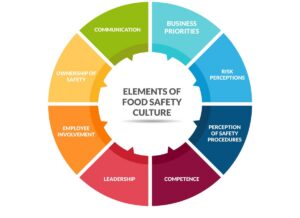
All of the technical effort quickly loses its effectiveness without the support of employees and management. The textbooks call this food safety culture. An excerpt from the Food Safety Authority of Ireland (https://www.fsai.ie)
Food safety culture encompasses how everyone, including managers and employees, think and act in their job on a consistent basis. It reflects the commitment to food safety at every step and within every role…. Food safety culture is “the way we do things around here” when it comes to safe food, whether people are watching or not. It’s the set of shared beliefs, values, and attitudes that guide everyone’s behavior—from managers to frontline employees—to ensure safe food is produced consistently. It is about how all current food safety systems interact with people to result in safe food. Food safety culture is the result of the relationship between the company’s food safety awareness and management, the environmental setting and the staff behavior within an organization.
This is illustrated by the interplay of three variables: food safety knowledge, understanding and awareness; environmental influences (infrastructure and equipment); and behavioral change. Each of these is important in order to support the food safety culture and a food safety system. In order to arrive at behavioral change, knowledge and technical influences must be in place.
Precursors to Behavioral Change:
Behavioral change occurs because the employee’s beliefs, based on credible information, lead to positive attitudes which in turn lead to behavioral change. It is a three step process. First, however, the employees must be persuaded, both to listen to the message and then to act on it.
Persuasion: Ideas about persuasion have been around for a long time. According to Aristotle, there are three kinds of persuasion (pp, 5-6, Petty and Cacioppo): the speaker’s character; the audience’s frame of mind; and the credibility or truth of the message.
The speaker must be a respected information source within the organization and communicate that to the employees. Employees must believe that the message is credible and proper.
The sanitarian or inspector might be a credible information source but they are not part of the food safety culture. The employees must be interested and involved in the presentation; they will be afraid of the sanitarian but persuaded by their managers. Technical support or service technicians will be knowledgeable and credible but, again, they are not part of the culture. The manager must be present during the program to give it credibility.
The presentation must be short and simple, in order to keep the employee’s attention. Finally the message must be credible and true. The ultimate goal is to change the employee’s attitudes and beliefs, leading to changes in behavior. If that information is not provided, and the program resorts to a lecture or sermon, the employee will find their own information other places.
Message: Plato viewed persuasion as the key to power and the message as key to persuasion. Clearly a persuasive, powerful message will sway audiences to more positive attitudes.
Message Factors: (a) Repetition – the research suggests that repeating a message improves retention of the information but not necessarily a change in attitude (presumably participants get tired, suspicious and possibly insulted, when the material is repeated several times). (b) Style – depending on the subject matter and the speaker, a joke may not always be effective (c) Speakers are more persuasive and seem more credible, if they look directly at their audience, speak forcefully (not hedging, using ‘um’, ‘eh’, ‘I guess’) and speak in a rapid, powerful tone.
Comprehension: the food safety culture, however close knit, will consist of a wide variety of social, economic and educational backgrounds. The message in a training program must be easily understood. Another factor of comprehension is the length and complexity of the message. Participants decide about the message’s value early and will get bored and tired easily; a few strong persuasive arguments will be effective.
Rewards: Rewards offered immediately at the end of the program, linked to the change in behavior, will be a better motivator.
Fear Arousal: While fear arousal can be a strong motivator for change, especially with experienced, well-educated employees, it will only be effective if there is an immediate effective coping strategy offered. So, if employees are trained to wash their hands as a means to prevent foodborne illness, as well as to prevent loss of their jobs, they will be motivated only after practicing the behavior successfully.
Beliefs: Beliefs are based on ‘the information that a person has about other people, objects and issues’. As mentioned before, managers must provide the information or employees will find information from the internet, from sources in their community and from other employees. The textbooks call this the ‘magic apron principle’ where employees will get their information second hand, often inaccurate, from sources they find familiar and not threatening. Therefore, managers must be sure credible information is available throughout the facility.
Attitudes: Beliefs lead to the formation of attitudes, positive or negative opinions about a subject. In turn, positive attitudes lead to behavior change based on two factors: the time between the attitude’s development and corresponding behavior; and the employees’ awareness of their attitude. The program presenter must link positive attitudes and the behavior, explaining how the two factors relate to each other.
For example, a training program at the facility’s hand sink might explain the scientific importance of proper handwashing, model the proper procedures and allow for the students to practice it with positive reinforcement. This design links a positive attitude, accurate information and behavioral change.
Other Factors Influencing Behavior Employees who are new hires, inexperienced or not self-monitoring or self-critical will often develop positive attitudes and change behaviors more readily. If they receive information from a credible source, they will not question it as much as experienced employees with their independent thought process (This emphasizes the importance of training new employees.)
If the behavior is practiced enough, it will persist as a habit, long after the training is over. Finally, if the behavior is modeled and practiced by a respective employee, others will see it as a norm, a behavior acceptable within the social network.
Sources:
Richard E. Petty, John T. Cacioppo ‘Attitudes and Persuasion: Classic and Contemporary Approaches’ 1981 (Dubuque Iowa: Wm. C. Brown)
Food Safety Authority of Ireland ‘Food Safety Culture’
https://www.fsai.ie/business-advice/starting-a-food-business/food-safety-culture