
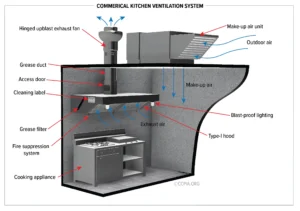
Fire Prevention: Airing It Out!
No food service subject seems more boring than the ventilation system. Yet, when the causes of food service fires are known, that equipment is a major culprit. Nothing is more sickening to a food service operator than hearing the crackling of flames moving through the restaurant’s ductwork. It is the sound of ‘down time’ for reclamation of the building, repair of equipment and infrastructure, purchasing new food inventory and retraining employees. While maintenance and cleaning certainly cost time in labor, planning can prevent fires, promote better cleaning and help employees’ comfort and health.
The cost of the exhaust system can range anywhere from five to twenty-five thousand dollars depending on the type and size of the exhaust hood, the ductwork, exhaust fan on the roof, the fire suppression system, the electrical equipment and of course the labor for installation. To add insult to injury, a large system inevitably requires make up air to provide a balance, after removing so much exhaust from the building.
What’s the Concern with Air Imbalance? The results of negative or positive air imbalance can be important. From a public health standpoint, make up air is critical to avoid a negative or positive air flow in the building. We’ll take a moment aside to discuss this critical problem. The building works toward a neutral air balance, whatever the cost: if the balance is extreme, the cost can also be extreme.
Negative air pressure pulls outside air into the building (suction). The ventilation system works harder as outside air is drawn through any crack or crevice in the building structure: this increases energy bills. Inward opening doors may fly open, potentially suctioning insects into the kitchen (a faulty screen door and negative air balance together could create an imminent restaurant closure as flies are so unsanitary!). The exhaust system works harder to exhaust grease-laden air, fighting incoming outside air. The exhaust fan on the roof works harder as a result. The pilot lights of equipment can extinguish, creating carbon monoxide poisoning.
Positive air pressure, in contrast, pushes air out of the building. External doors can be difficult to open or close. This can be frustrating for customers and possibly unsafe.
Both types of imbalance can compromise the safety and comfort of both restaurant patrons and employees, leading to costly repairs and operational inefficiencies. It is crucial for restaurant
managers to address these issues promptly to maintain a safe and efficient environment.
Talking About Restaurant Fires
The frequent use of stoves, ovens, grills, and deep fryers produces a great deal of flammable grease, making restaurant kitchens especially prone to fires. Some common fire risks include the following:
Unattended Cooking: Once cooking equipment has warmed up for use, employees are tempted to leave it that way, even when they leave for a break or other work. They may leave food unattended, resulting in overheating or burning;
Grease Fires: Cooking oils and grease are highly flammable. New synthetic oils have even higher flame points, sometimes higher than the fire suppression system can detect, causing fires to burn longer before the alarms sound.
Regularly Test, Maintain and Clean Equipment – Follow the manufacturer’s specifications based on the number of hours the equipment is used, not the number of weeks or months.
Flammable Surfaces – Wiping cloths left on cooking surfaces, paper products, styrofoam, any number of materials can catch fire from grease splatter;
Faulty or Improperly Maintained Kitchen Equipment – Failure to maintain or clean equipment leads to soil accumulations which can ignite. Frayed, exposed wiring and overloaded circuits can overheat. Gas lines can also ignite if they leak or are not maintained;
Soiled Exhaust Systems – Many restaurants produce a great deal of grease which accumulates in the plenum behind the filters, the vertical and horizontal ductwork and inevitably the exhaust fan on the roof.
While most restaurants clean the filters routinely (hint: use a pressure washer or a car wash system to remove grease efficiently), grease still migrates beyond that point, into the plenum cavity and the ductwork. The entire ventilation system must be cleaned routinely, depending on use, from top to bottom. This requires cleaning from the roof down to the cooking surfaces, usually during the restaurant’s down time.
Finally employees must be properly trained in using commercial equipment. Be sure they know how to use fire extinguishers. Conduct regular fire drills and post response procedures to follow in case of a fire. Maintain a list of people to call in case of a fire. Fire suppression systems have a specific design and use. While it is tempting to save money by not recharging, cleaning or maintaining the system, the results of that short term saving could be a disaster.
Nothing takes the place of regular training and routine monitoring of the kitchen. Add areas of concern to the cleaning and maintenance schedule so problems are found and corrected before they develop into major concerns. The author was called out to a restaurant fire which started when employees cleaned their bicycle with gasoline next to the hot water heater. In another case, the fire suppression system discharged prior to this incident and was never recharged again. In yet another case, the fire suppression nozzles are not set at the proper elevation to put out a fire on the cooking surfaces. They were heavily soiled, not regularly cleaned.
The following sites were consulted for this blog posting:
Hiller Fire – https://hillerfire.com/
National Fire Protection Association https://www.nfpa.org/
BSI (Becks Sanitation – Several postings about safety) blog https://www.bsirecycling.com/blog-home